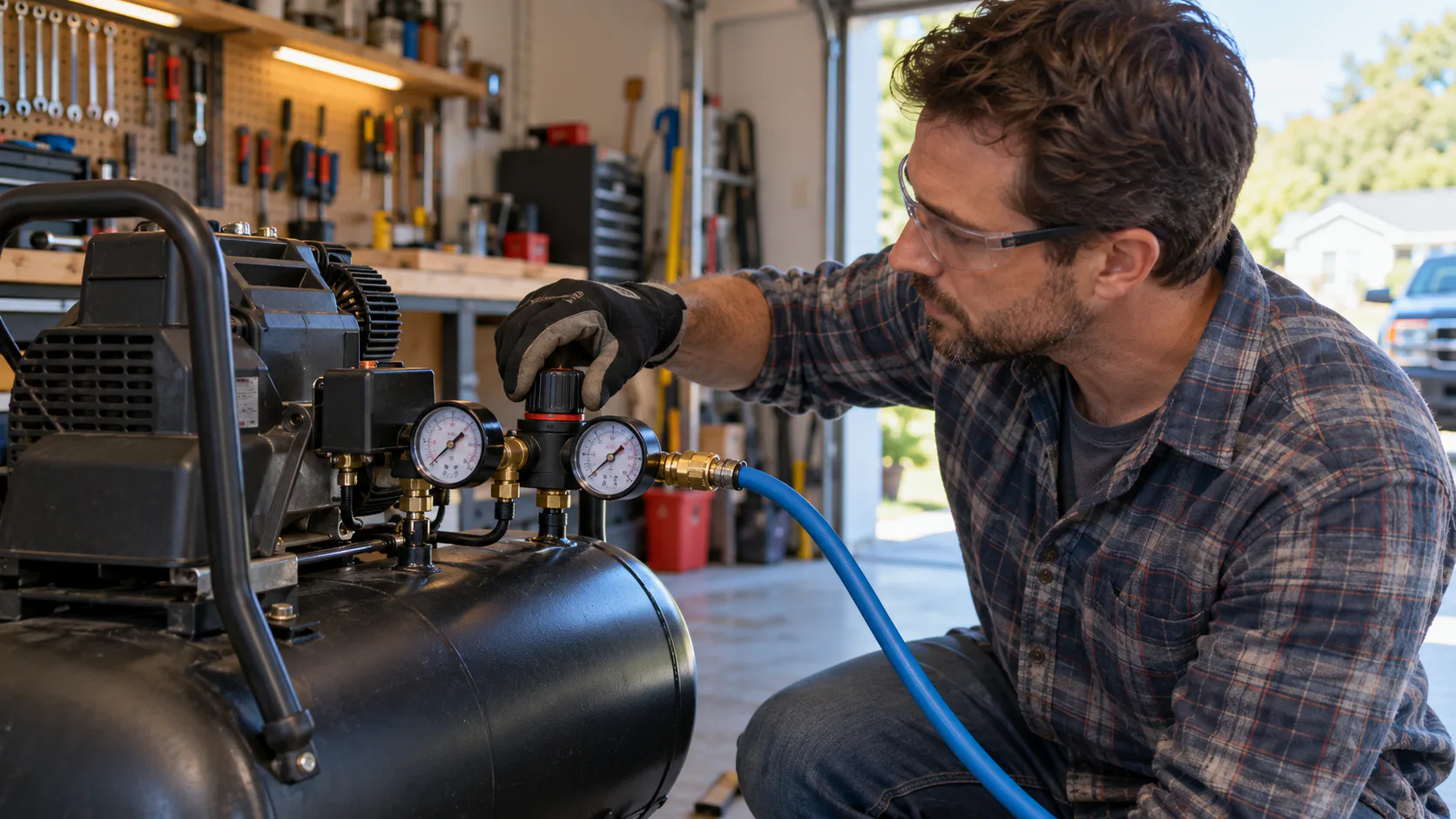
For an air-tool comparison, find the compressor's delivered airflow with a pressure attached. On the Makita MAC2400 page it reads Performance (90 PSI): 4.2 CFM. Copy those three parts together: the value, the pressure, and the label. Several other numbers on the same page look bigger or more prominent but are not delivered CFM at a working pressure.
| What you see on the page | What it is | Use it as compressor CFM? | Manufacturer example |
|---|---|---|---|
| CFM at a stated PSI | Airflow at that pressure | Yes, with its pressure | Makita MAC2400: Performance (90 PSI): 4.2 CFM |
| The same kind of figure at 40 PSI | Airflow at a lower pressure | Only against a tool figure stated at 40 PSI | Makita MAC2400: Performance (40 PSI): 4.8 CFM |
| SCFM delivered at a stated PSI | Airflow at standard conditions | No. Record it as SCFM rather than relabelling it CFM | DEWALT DWFP55130: 3.0 scfm delivered @ 90 PSI |
| CFM Displaced | Pump displacement, not delivered air | No | Rolair 3095K18: CFM Displaced: 17.2 CFM, beside CFM Delivered: 12.5 CFM @ 90 PSI |
| Maximum pressure | A pressure limit, not airflow | No | Metabo HPT EC914S: 200 PSI maximum, beside 4.0 CFM at 90 PSI |
| Tank size or horsepower | Storage and motor size | No | Makita MAC2400: 4.2 gallon tank |
When the delivered unit is CFM and the pressure matches the tool record, the matcher can set the two published figures beside each other. It keeps SCFM-labelled records separate.
Where to look
Start with the manufacturer's page for your exact model and scroll to the specification table. Search the page for CFM, SCFM, air delivery, performance, or 90 PSI. The Metabo HPT EC914S page groups its two rows under Air Delivery; the Makita MAC2400 page calls them Performance. The wording differs, so copy it as printed.
If the compressor is in front of you, the label on the unit and the owner's manual are also primary sources. Read them the same way: look for a flow value tied to a pressure, and note whether the label says delivered, displaced, or SCFM.
A retailer listing can point you to the model number, but its headline often shortens or mixes the figures. Confirm the number on the manufacturer's page before relying on it.
Keep the pressure with the number
Many pages publish airflow at two pressures. The California Air Tools 8010 page gives:
3.10 CFM @ 40 PSI
2.20 CFM @ 90 PSI
The higher figure belongs to the lower pressure. Writing down 3.10 CFM without its pressure, then comparing it with a tool figure stated at 90 PSI, mixes two conditions. Air Tool Match's current tool records are published at 90 PSI, so its compressor comparisons use the 90 PSI row. That reflects the current data, not a rule that 90 PSI suits every application.
Displaced is not delivered
The Rolair 3095K18 page prints both kinds of figure in one block:
CFM Displaced: 17.2 CFM
CFM Delivered: 12.5 CFM @ 90 PSI
The displaced figure describes the pump, not the air delivered at a working pressure. The Compressed Air and Gas Institute handbook defines displacement separately from delivered capacity, and defines rated capacity as airflow at a rated pressure. For a comparison, record CFM Delivered: 12.5 CFM @ 90 PSI with its label.
Maximum PSI is a different field
A maximum-pressure headline is often the largest number on the page. The Metabo HPT EC914S lists 200 PSI maximum pressure; Makita lists 130 PSI for the MAC2400. Neither is airflow. The guide on why maximum PSI is not a delivery rating shows three compressors where the highest maximum pressure does not come with the highest CFM at 90 PSI.
CAGI's sample rotary-compressor data sheet keeps the two in separate fields: rated capacity at full-load operating pressure, and maximum full-flow operating pressure.
What CAGI verification covers
CAGI's Performance Verification programme publishes standardized data sheets for rotary compressors from 5 to 200 horsepower and refrigerated dryers from 50 to 1,000 SCFM. The small portable compressors in Air Tool Match's records sit outside that scope, so they appear here as manufacturer-page examples only, not as CAGI-verified models. Even the sample sheet notes that its sample data is not independently verified.
A checklist for any compressor page
- Confirm the manufacturer and exact model number.
- Find the specification table, label, or manual.
- Copy the airflow value, its unit, its pressure, and its label together.
- Keep each pressure row separate.
- Skip displacement, maximum pressure, tank size, and horsepower as stand-ins for delivered airflow.
- Save the source URL and the date you checked it.
- If no flow figure is tied to a pressure, record it as not published.
What the rating does not tell you
A published CFM rating is the manufacturer's stated figure, not a measurement of the air reaching a tool in your shop. It does not account for hose layout, regulator setting, leaks, tank recovery, duty cycle, electrical supply, or several tools running at once. Air Tool Match compares published figures only; it does not size a compressor or give installation or safety advice. For an equipment or operating decision, take the exact models and your conditions to the manufacturer or a qualified professional.
The records directory shows the exact label stored for every compressor. If a linked page now shows something different, trust the manufacturer page and treat the site record as due for review.
Sources checked
- Makita MAC2400
- Metabo HPT EC914S
- Rolair 3095K18
- California Air Tools 8010
- CAGI Air Compressor handbook, definitions on PDF pages 25 through 28
- CAGI Performance Verification programme
- CAGI sample rotary-compressor data sheet
Checked 2026-09-28. Manufacturer pages and programme scope can change.